
We placed a thin plastic sheet over a subwoofer and poured a small layer of water on top. As the speaker played different frequencies of sound waves, the vibrations from the woofer created dynamic ripple and wave patterns on the water’s surface, making the invisible sound field visible through fluid motion.
Team Third – Water on Speaker
Cooper Wyrick
Team First
MCEN 4151-001
November 16th, 2025
Teammates: Zach Taylor, Kai Hansen
For this project, our group explored how sound vibrations manifest visually on the surface of water. The setup involved placing a thin sheet of plastic over the woofer of a home sound system, pouring a shallow layer of water on top, and observing the resulting patterns at different frequencies. The purpose of the video was to capture how sound pressure waves translate into motion within a fluid, creating ripples and patterns. This experiment was performed with the help of my teammates. Zach Taylor assembled the speaker, plastic, and water layers. Kai Hansen illuminated the surface using his iPhone flashlight to enhance the visibility of the water movement. Our intent was to make the sound “visible.”
The flow apparatus consisted of a Yamaha woofer (Model YST-SW010) connected to a JVC stereo receiver (Model RX-R73TN) playing test tones. A Ziploc plastic sheet was cut and laid across the speaker opening, forming a shallow basin. We added approximately 3 cm of tap water across the surface. When the woofer vibrated, its oscillations transmitted directly into the thin plastic, which displaced the water. The resulting flow was an unsteady motion driven by vertical oscillations of the subwoofer. The field of view covered roughly 1 ft × 2 ft, corresponding to the central region of the plastic. The schematic diagram below shows the setup.
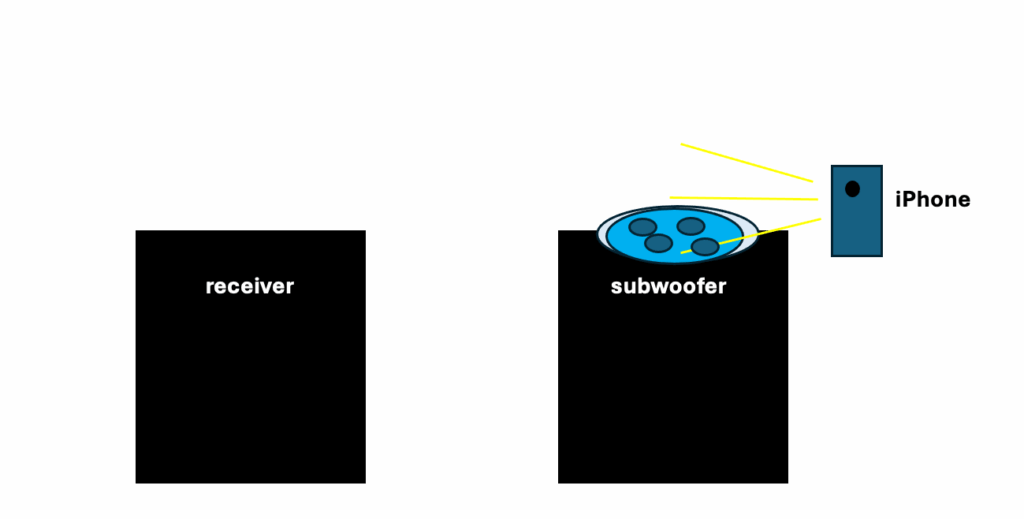
Figure 1: Schematic of Setup
To characterize the flow, I estimated the Reynolds number for the moving water layer. Because the water motion is caused by the speaker’s oscillations rather than a constant current, I used an oscillating velocity based on visual inspection. This was approximately U = 0.05 – 0.10 m/s. The characteristic length was taken as the ripple wavelength, D = 0.02 m. Using water’s kinematic viscosity at room temperature (ν = 1.004 x 10^-6 m^2/s), the Reynolds number becomes Re = (UD)/ν = (0.10 m/s)(0.02 m)/(1.004 x 10^6 m^2/s) = 2.0 x 10^3 for U = 0.10 m/s and Re = (UD)/ν = (0.05 m/s)(0.02 m)/(1.004 x 10^6 m^2/s) = 1.0 x 10^3 for U = 0.05 m/s.
Therefore, the Reynolds number lies between 1000 and 2000. This aligns with what our team observed. The surface patterns were organized and not fully turbulent, but displayed complex waves. The primary forces shaping the flow include unsteady pressure oscillations from the speaker, gravitational forces that flatten the surface, and surface tension, which plays a significant role because the water layer was thin. With higher frequencies, smaller ripples formed. With lower frequencies, larger waves formed. The wave patterns we observed resemble what is displayed in cymatics, where vibrating plates or speakers create standing wave geometries in fluids. For example, Stanford’s cymatics project documents how different frequencies on a speaker dish cause liquids to self organize into polygonal patterns (Stanford). These visualizations reinforce the physics behind our own setup.
For visualization, we used tap water poured over Ziploc brand plastic sheets to span the speaker. The plastic isolated the water from the woofer while transferring vibrations. Environmental conditions were typical indoor room conditions. There was a stable 70 degree Fahrenheit temperature and no ambient airflow. For lighting, we used a strong light from an iPhone flashlight shining across the surface. This illumination enhanced the highlight to shadow contrast of the ripples, which made the wave patterns easier to capture on camera.
The video was taken using an iPhone SE (3rd generation) digital camera. The approximate focal length is 3.99 mm. The camera was positioned about 2 ft from the water surface to frame about 1 x 2 ft. The original video resolution was 1080 x 1920 pixels, and the final version was cropped to 772 x 584 pixels. Because the shot was recorded in slow motion, the phone likely used 120 fps at an exposure around 1/1000 s, with an aperture of f/1.8 and ISO of 400 (Apple). For post processing using the “Colourtone” app, I increased contrast and decreased color temperature to emphasize highlights. I also cropped the frame to remove background clutter.
The video reveals an interaction between sound waves and fluid motion. I like the captured geometric patterns on the water surface. This experiment visually confirms that sound waves impose forces on nearby fluids. Something less ideal is that some of the wrinkles in the plastic sheet decrease the clarity of the ripples. Our intent to visualize the real world translation of sound vibrations into fluid motion was fully achieved. I would improve the setup by using a more uniformly tensioned sheet of plastic or a frequency generator instead of a stereo receiver. Future work could compare different frequencies, speaker sizes, or membrane materials.
Appendix
Apple Inc. iPhone SE (3rd Generation) Camera Technical Specifications. Apple Support, https://support.apple.com. Accessed 16 Nov. 2025.
Stanford, Nigel. Cymatics. John Stanford Music, 2014, https://nigelstanford.com/cymatics. Accessed 16 Nov. 2025.
4 Comments. Leave new
I think this is a cool way to visualize the impacts of frequency vibrations on water. It could be interesting to play it back at a slower speed too to see the water’s reaction in a more detailed way.
Hi Cooper, I think this is a really great visualization. The patterns caused by the vibrations are really interesting. The evenness of the waves is very visually appealing. Additionally, the side angle that you selected to take this from adds a lot of depth to the image.
Which angle did you record this video from? I wonder how it would have looked if you had recorded it from a top down view. I like the ripples formed by the subwoofer; they remind me of the surface of a golf ball.
It was so interesting to see sound waves visualized in this manner! What kind of music/ sound did you use to obtain this type of fluid motion? Did you experiment with any other types of sounds before settling on this one?