
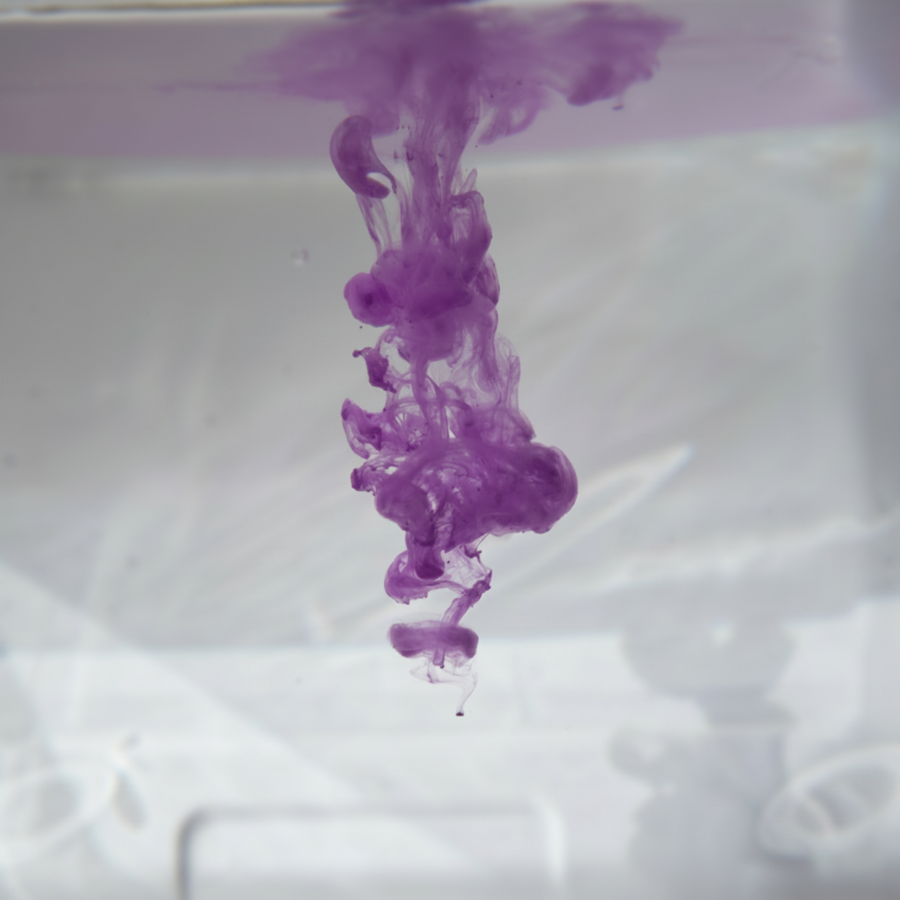
Drop of purple dye in a small tank of water diffusing other wise known as the Rayleigh-Taylor instability.
Evan Mason
Get Wet
September 18, 2026
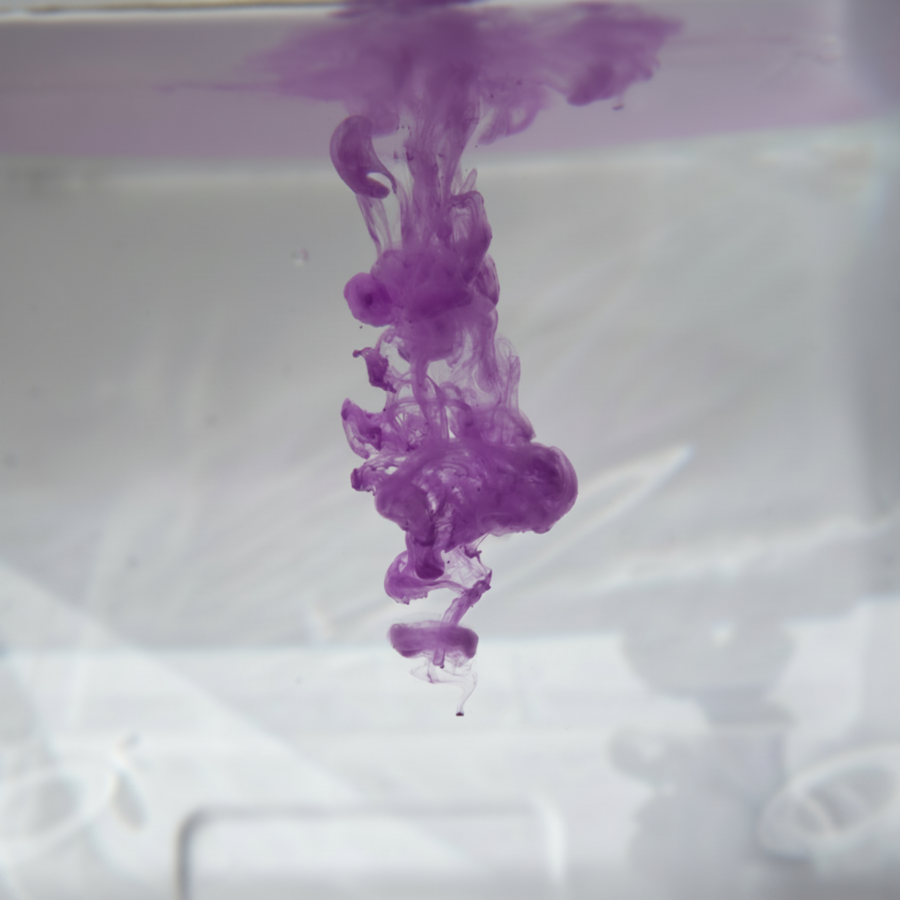
The purpose of this image was to capture how a small amount of dense, dyed liquid behaves as it sinks through still water, and how a smooth stream of dye breaks into rounded lobes and thin filaments as it falls. My first attempt was to drop purple dye into a bowl of water sitting in direct sunlight and photograph it from above, looking down into the bowl. This did not work due to reflection of lighting and angle, so I changed the setup. For the final image (Figure 1), I filled a clear tank with water, stood a white lid behind it as a background, and photographed the dye from the side as it fell through the water.
Figure 1. Purple dye sinking through still water in a clear tank.
The setup is shown in Figure 2. A clear rectangular sock drawer tank measuring 12 x 6 x 8 inches was filled with room temperature tap water to a depth of 7 inches and left to settle so the water was as still as possible before each drop. The white lid stood behind the tank so that it filled the background of the frame. Dye was released from a plastic syringe held about 2 inches above the water’s surface, so each drop fell through the air, struck the surface, and continued down through the water. Seen from the side a slightly denser liquid sinking through a lighter one is called a negatively buoyant plume.
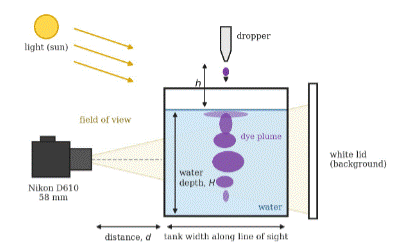
Figure 2. Sketch of the experimental setup
The main force acting on the fluid is gravity. The dye solution is slightly denser than the water so it is pulled downward while the surrounding water resists through pressure and viscous forces. The drop also carries some momentum from its fall. In researching this behavior, I found that Thomson and Newall (1885) described how a drop of ink falling into water can descend as a ring with strong rotation and how the ring becomes uneven as it falls because the parts carrying more ink move down faster than the rest. Peck and Sigurdson (1994) observed that vortex filaments can extend from the ring back toward the surface, and that some of these filaments become unstable as the ring moves downward creating a flaring out effect. Biswas (2018) notes that a faster entry tends to break the ring apart before a clean ring shape forms. Because my drops fell from a height the ring broke down early and the image shows a later stage in which the dye has become a lobed plume. The lobes themselves are consistent with the Rayleigh-Taylor instability, which occurs at the boundary between two fluids of different densities when the heavier fluid pushes into the lighter one (Wikipedia contributors 2026).
To estimate the scales of the flow, I treated the plume as a column of width D = 2 cm. The dye is diluted by the surrounding water as it sinks so I assumed an average density excess of about 0.5% compared to clear water. This gives a reduced gravity of g′ = gΔρ/ρ = (9.81 m/s2)(0.005) ≈ 0.05 m/s2 and an Atwood number of A = (ρdye – ρwater)/(ρdye + ρwater) ≈ 0.0025. An Atwood number this close to zero means the instability tends to grow as symmetric fingers rather than as large bubble-like plumes (Wikipedia contributors 2026), which matches the rounded lobes in the image. The only source of motion is the density difference itself so I chose a buoyancy velocity scale.
U ~ (g′D)1/2 = [(0.05 m/s2)(0.02 m)]1/2 = 0.03 m/s
Using ν = 1.004 × 10⁻⁶ m2/s for water at 20 °C, the Reynolds number is
Re = UD/ν = (0.03 m/s)(0.02 m) / (1.004 × 10⁻⁶ m2/s) = 6 × 10²
A Reynolds number of about 600 means inertial forces are much larger than viscous forces, but not by enough to expect fully developed turbulence so this agrees with the image. The large lobes are smooth and coherent, and fine-scale structure only appears in the thin filaments at their edges, which suggests the flow is unsteady and transitional but still mostly laminar. Dye also diffuses very slowly through water compared with how fast it is carried by the flow, so the edges of the dye act as markers of the fluid and the shapes in the image are set by the motion of the water rather than by diffusion. At this velocity, the plume would cover the roughly 8 cm shown in the image in about L/U = (0.08 m)/(0.03 m/s) ≈ 3 s.
The visualization technique was dye injection. I used purple body paint in a syringe, released one drop at a time into water at about 20 degrees Celsius. Purple was a good choice because it contrasts strongly with a white background and the tank water is otherwise clear. The lighting came from direct sunlight falling on the white lid, which acts as a bright, diffuse backdrop. The dye absorbs part of the light passing through the tank, so the plume shows up as a darker purple shape against the lit background. To repeat the image, fill the tank, wait for the water to stop moving, place the lid behind it, focus on the spot where the drop will land, and release one drop while taking a series of photographs.
The image was taken with a Nikon D610, a full-frame digital SLR, using a Nikon 24-85mm f/3.5-4.5G ED VR AF-S NIKKOR lens at a focal length of 58 mm. The camera was about 12 inches from the tank, and the field of view of the final image is about 6 inches across. I shot in aperture priority mode at f/4.5 with a shutter speed of 1/4000 s and an auto ISO, using pattern metering. The original file is 6016 × 4016 pixels in the Display P3 color profile, and the final image is 1404 × 1396 pixels, cropped to a nearly square frame. I chose aperture priority so I could control depth of field directly. At f/4.5 the plume stays sharp while the background and the far edges of the tank blur, which helps the dye stand out.
The only image processing to the photo was cropping into a square aspect ratio and very light adjustments to vibrance and saturation.
The image shows the plume in the middle of its fall several seconds after the dye hit the water. At the top, dye has spread out along the water surface and tinted the water there. Below that, a column of dye descends and widens into rounded lobes with swirling structure. I like how clearly the purple separates from the pale background and how the soft background lets the shapes of the lobes stand out. The physics of a density driven flow are shown well, since the lobes and folds are what a Rayleigh-Taylor type instability would produce, and the rolled-up edges hint at the rotation Thomson and Newall (1885) described. What I dislike is that the top edge of the frame cuts off the place where the dye enters, so the start of the plume is missing, and that reflections and out of focus shapes are visible in the lower background. I met my main intent of freezing a dye plume with clear structure, but I did not capture an intact vortex ring. To improve the image, I would use more even lighting and background, frame the shot to include the free surface, and release drops from several heights, since Chapman and Critchlow (1967) report an optimum release height for forming a well defined ring. I would also record video to see how the lobes develop over time. A question I still have is how much the dye concentration changes the number and size of the lobes.
References
Biswas, D. (2018). Investigating the perturbed geometries of vortex rings in free fall through another liquid. arXiv:1805.07926. https://arxiv.org/pdf/1805.07926
Chapman, D. S., and Critchlow, P. R. (1967). Formation of vortex rings from falling drops. Journal of Fluid Mechanics 29: 177-185.
Peck, B., and Sigurdson, L. (1994). The three-dimensional vortex structure of an impacting water drop. Physics of Fluids 6(2): 564-576.
Thomson, J. J., and Newall, H. F. (1885). On the formation of vortex rings by drops falling into liquids, and some allied phenomena. Proceedings of the Royal Society of London 39: 417-436. https://doi.org/10.1098/rspl.1885.0034
Wikipedia contributors. (2026). Rayleigh-Taylor instability. Wikipedia, The Free Encyclopedia. Accessed September 20, 2026. https://en.wikipedia.org/wiki/Rayleigh%E2%80%93Taylor_instability

