
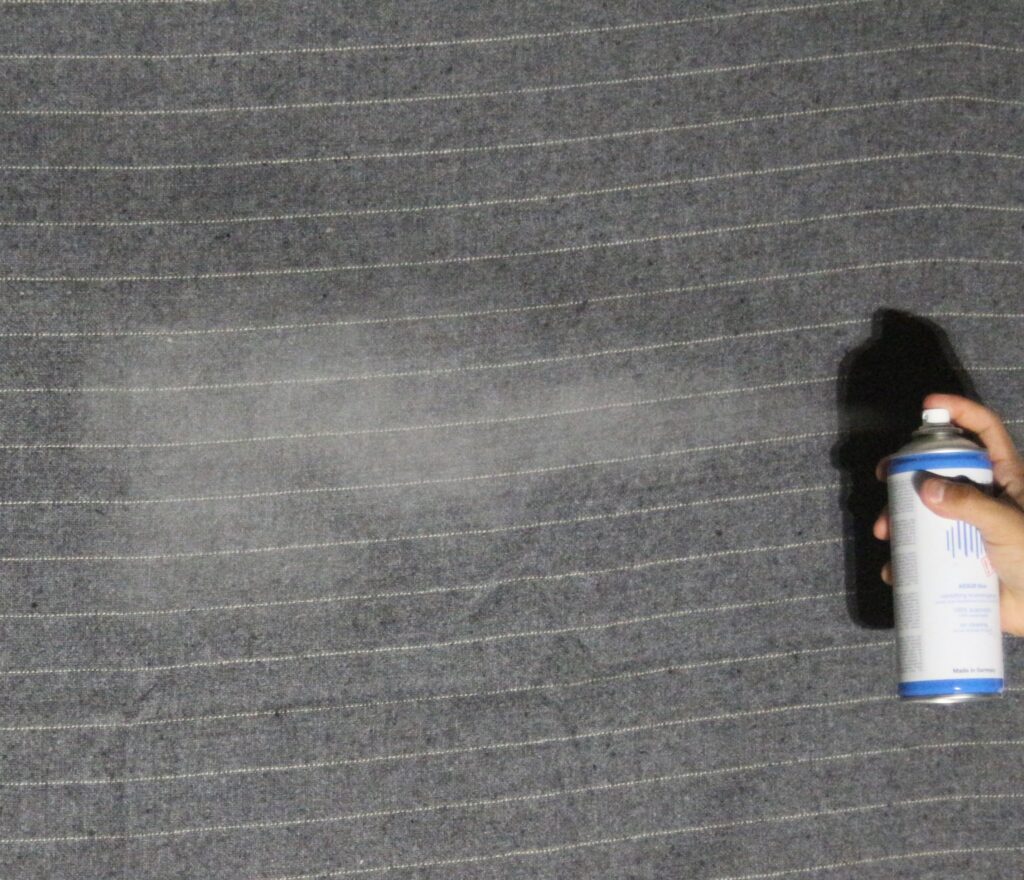
Reflective 3D scanner spray atomizes as it leaves the pressurized can. A plume forms as the spray is slowed down by the still atmosphere, the cloud disperses.
Visualizing an Aerosol Spray Plume Against a Dark Backdrop
Ken Fujiwara, Get Wet Assignment, ATLS 4151-5151, September 30, 2026
Collaborators: My dad helped me set up the dark canvas backdrop. My sister operated the camera while I sprayed, and she also held the light on some of my earlier attempts. I chose the camera settings and planned the overall setup.
1. Context and intent
This image was made for the Get Wet assignment in Flow Visualization. I wanted to show how a spray leaves a pressurized can as a fast, narrow jet and then spreads out into a soft, widening cloud as it mixes with the still air around it. I chose a spray can because the plume is already visible and I did not have to add any smoke or dye. Early attempts failed when I attempted to use the black night sky as the backdrop, and there was nothing for the camera to focus on. Timing manual focus with the spray made this extremely difficult. Moving the light to the ground, aimed up at the spray, made the plume stand out against the backdrop. My dad helped me hang the backdrop, my sister held the light on those early tries and later took the photo while I sprayed, I picked the camera settings.
2. Flow and apparatus
The flow is a spray moving sideways through still air at night in front of my house. I held the can in my right hand and sprayed it sideways, parallel to a dark grey pinstriped canvas that hung about 2 ft (0.6 m) from the camera (Figure 2). The can is about 6.5 cm wide, so I used it as a ruler. The picture covers about 0.5 m, and the visible plume is about 35 cm long.
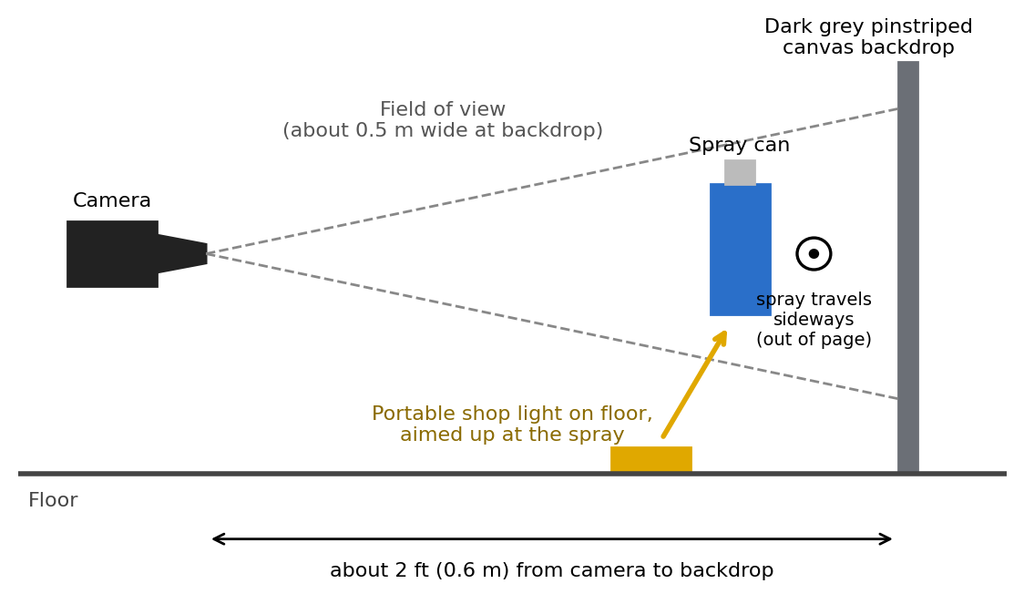
Figure 2. Side-view sketch of the setup (not to scale).
The propellant in the can boils almost instantly as it leaves the nozzle, which blasts the product into a cloud of tiny droplets (Multiphase Flow and Spray Systems Laboratory, n.d., Myatt et al., 2022). The gas leaves at about the speed of sound, and larger droplets get pulled off the edge of the plume as thin strings of liquid (Myatt et al., 2022). Past the nozzle the plume acts like a jet. It mixes with the surrounding air, gets wider, and slows down (University of Iowa, n.d.). By the left end it is moving so slowly that the room air pushes it around and the droplets likely dry up, so the plume fades out. Myatt et al. studied an inhaler and not a scanning spray, but both are pressurized propellant sprays, so I expect the same behavior here.
The Reynolds number of a round jet is Re = U D / ν (University of Iowa, n.d.), where U is the speed out of the nozzle, D is the nozzle opening, and ν is the kinematic viscosity of air.
Re ≈ (20 m/s)(0.001 m) / (1.5 × 10⁻⁵ m2/s) ≈ 1 × 10³ (low end)
Re ≈ (146 m/s)(0.001 m) / (1.5 × 10⁻⁵ m2/s) ≈ 1 × 10⁴ (high end)
I did not measure U or D. The nozzle opening of about 1 mm and the low speed of 20 m/s are my estimates. The high speed of 146 m/s is the speed of sound in the vapor from Myatt et al. (2022), and my can may use a different propellant, so the real value is probably in between. Either way the spray is most likely turbulent near the nozzle, which matches the blotchy, cloudy look of the plume.
The plume moves a few meters per second over most of its length, so during 1/200 s (0.005 s) it travels about 1 cm. One pixel in my picture is about 0.2 mm, so the spray is blurred over many pixels. Freezing it to one pixel would take about 1/30,000 s, which is beyond my camera and light. Small, fast droplets need brighter and shorter flashes of light to freeze (Multiphase Flow and Spray Systems Laboratory, n.d.). That is why the plume reads as a soft haze instead of sharp swirls, which I think suits a cloud-like spray.
3. Visualization technique and lighting
The flow is made visible by the reflective spray itself. I only wanted to use this spray because it might be high visibility and maybe even reflective, and it works well when I 3D scan things. It is intended to be sprayed onto objects that are hard to 3D scan, such as reflective or transparent surfaces, and it also increases scanning accuracy in general. I used AESUB blue, an expensive 3D-scanning spray. It sprays a fine white coating, and it is meant to vanish on its own within a few hours (AESUB, n.d.). The data sheet says to spray it from 15 to 20 cm away. I held the can closer to the right edge of the frame and sprayed across the camera view. The mist is white, so I placed it in front of a dark grey backdrop for contrast. It was dark, the shot was taken at 10pm, and the camera flash did not fire. The only light was a Harbor Freight portable shop light placed on the floor and aimed up at the spray. Lighting the plume from below makes the mist glow, and it also puts the shadow of the can up the fabric, visible to the right of the plume. To repeat this, you need a pressurized spray can with a light, fine mist, a dark non-glossy backdrop, a dim room, and one strong light aimed at the plume from a low angle.
4. Photographic technique
I used a Canon EOS Rebel SL1 (digital) with a Canon EF 35-105mm f/4.5-5.6 USM lens set to 35 mm. The settings were f/4.5, 1/200 s, and ISO 6400. I chose a wide aperture and a high ISO because the room was dark and I wanted a shutter speed fast enough to avoid blurring from hand-held shooting and from the moving spray. The camera was about 2 ft from the spray, the spray was a few feet away from the backdrop. I focused manually on the fabric, because the spray itself gives the camera nothing to lock onto. I did not do any photoshop editing other than cropping.
5. What the image shows and reflection
The image shows the spray leaving the can and spreading into a cone that fades into the air, with the can’s shadow, my hand, and the pinstriped canvas giving it context. I like that the plume’s mottled texture shows a flow that is breaking up as it mixes. I wish the fabric was black, instead of gray with white stripes. I dislike that the plume is soft and low in contrast near its end, and that the high ISO adds some noise. The fluid physics come through reasonably well, you can see the jet widening and fading, though the fast, narrow part near the nozzle is hidden behind the shadow of the can and my hand. I partly met my intent since I wanted a clearer view of the jet’s early eddies. If I did it again, I would use a flat black backdrop, a stronger or flashed light to allow a much faster shutter speed, and a camera angle that shows the nozzle. I would also measure the nozzle size and spray speed instead of estimating them, add a ruler to the backdrop, and try a side-lit and a back-lit version to compare.
References
AESUB. (n.d.). AESUB blue vanishing scanningspray, technical data sheet (DSN00007). https://www.123-3D.nl/pdf/DSN00007_TDS_EN.pdf
Multiphase Flow and Spray Systems Laboratory, University of Toronto. (n.d.). Atomization & sprays. https://mussl.mie.utoronto.ca/research/atomization-sprays/
Myatt, B. J., Versteeg, H. K., Hargrave, G. K., Long, E. J., Gavtash, B., Lewis, D. A., Church, T., & Brambilla, G. (2022). Unlocking further understanding of the atomization mechanism of a pressurized metered dose inhaler. Aerosol Science and Technology, 56(11), 1022-1032. https://www.tandfonline.com/doi/pdf/10.1080/02786826.2022.2116305
University of Iowa. (n.d.). Chapter 7 free shear flows, jets, mixing layers and wakes (Pope), part 1, round and 2D jets [Course notes]. https://stern.lab.uiowa.edu/sites/stern.lab.uiowa.edu/files/2025-11/Chapter-7-Free-Shear-Flows-Part-1-final.pdf

