Best of Web – Cody Williams
http://https://youtu.be/0h16Tyn2138
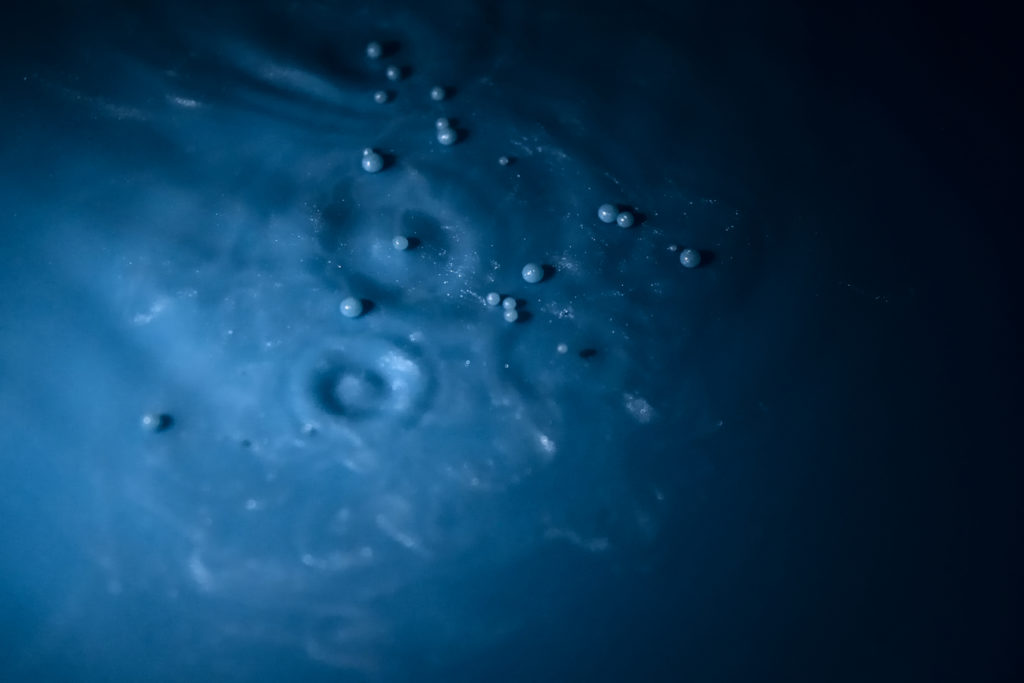
If the surface tension varies along an interface between two fluids, an imbalance of forces causes the Marangoni effect to occur. Surface tension depends on temperature and concentration of the surface, so changes or fluctuations in these two properties can cause a flow. This can occur when evaporation induces a flow inside of a droplet. In the case shown in the video, a soap film is stabilizing the surface tension of the bubble, which allows it to self-heal after the water drop passes through.
I enjoyed this particular example because of its sheer simplicity and captivating qualities, however, there is quite a bit of science and physics of what is going on within the soap-bubble and with surface tension. In this way the video is deceptive yet eye-catching. Surrounding the base of the bubble, ripples extend outward, exhibiting the appearance of buoyancy and is another great example of fluid flow dynamics and its associated properties.
This clip was shot by Gaven Mitchell, a student of Scientific Photography at RMT University, and Vision Research’s own Phil Taylor, an Application Engineer in Singapore.
Search
Categories
Flow Vis Guidebook
- Introduction to the Guidebook
- Overview 1: Phenomena. Why Does It Look Like That?
- Overview 2: Visualization Techniques
- Overview 3: Lighting
- Overview 4 - Photography A: Composition and Studio Workflow
- Overview 4 - Photography B: Cameras
- Overview 4 - Photography C: Lenses - Focal Length
- Overview 4 - Photography C: Lenses - Aperture and DOF
- Overview 4: Photography D: Exposure
- Overview 4 - Photography E - Resolution
- Overview 5 - Post-Processing
- Clouds 1: Names
- Clouds 2: Why Are There Clouds? Lift Mechanism 1: Instability
- Clouds 3: Skew - T and Instability
- Clouds 4: Clouds in Unstable Atmosphere
- Clouds 5: Lift Mechanism 2 - Orographics
- Clouds 6: Lift Mechanism 3 - Weather Systems
- Boundary Techniques - Introduction
- Dye Techniques 1 - Do Not Disturb
- Dye Techniques 2 - High Visibility
- Dye Techniques 3 - Light Emitting Fluids
- Refractive Index Techniques 1: Liquid Surfaces
- Refractive Index Techniques 2: Shadowgraphy and Schlieren
- Particles 1- Physics: Flow and Light
- Particles 2: Aerosols
- Particles 3: In Water
- Particles 4 -Dilute Particle Techniques
- Art and Science
- TOC and Zotpress test
- Photons, Wavelength and Color