Best of Web // Austin Ramirez
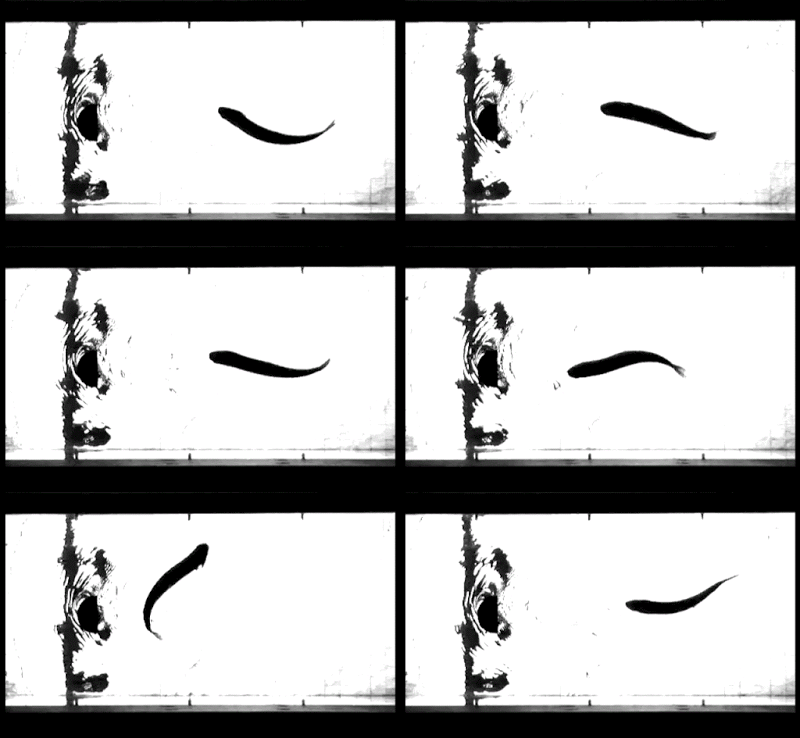
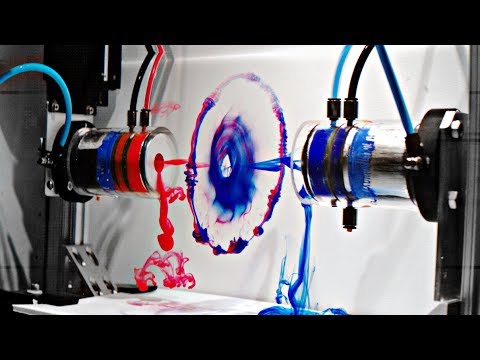
In this video, Destin Sandlin of smarter every day and an associate, David Linderman, investigated the ideal collision of vortex rings. To conduct this experiment, two vortex rings made out of ink were created and collided under water in order to see what type of fluid mechanics would occur when such an event happened. This was an incredible undertaking as making the rings collide perfectly was no simple task and took several years of refinement on the system that was used to conduct the experiment. However, The experiment yielded incredible results. The fluid mechanics are clearly seen at work as the vortices collide and the ink spreads out and then forms secondary vortices. Although the fluid mechanics of much of this process are very complicated, and the mechanics of the secondary rings remain unknown, there is incredible beauty here in the complexity and unpredictability of the formation and collision of near perfect vortices.
Image Source: https://www.youtube.com/watch?v=EVbdbVhzcM4
Original Author: Destin Sandlin
Search
Categories
Flow Vis Guidebook
- Introduction to the Guidebook
- Overview 1: Phenomena. Why Does It Look Like That?
- Overview 2: Visualization Techniques
- Overview 3: Lighting
- Overview 4 - Photography A: Composition and Studio Workflow
- Overview 4 - Photography B: Cameras
- Overview 4 - Photography C: Lenses - Focal Length
- Overview 4 - Photography C: Lenses - Aperture and DOF
- Overview 4: Photography D: Exposure
- Overview 4 - Photography E - Resolution
- Overview 5 - Post-Processing
- Clouds 1: Names
- Clouds 2: Why Are There Clouds? Lift Mechanism 1: Instability
- Clouds 3: Skew - T and Instability
- Clouds 4: Clouds in Unstable Atmosphere
- Clouds 5: Lift Mechanism 2 - Orographics
- Clouds 6: Lift Mechanism 3 - Weather Systems
- Boundary Techniques - Introduction
- Dye Techniques 1 - Do Not Disturb
- Dye Techniques 2 - High Visibility
- Dye Techniques 3 - Light Emitting Fluids
- Refractive Index Techniques 1: Liquid Surfaces
- Refractive Index Techniques 2: Shadowgraphy and Schlieren
- Particles 1- Physics: Flow and Light
- Particles 2: Aerosols
- Particles 3: In Water
- Particles 4 -Dilute Particle Techniques
- Art and Science
- TOC and Zotpress test
- Photons, Wavelength and Color